


INTRODUCTION
The originator and initiator of the project implemented at the Sybir Memorial Museum is Prof. Krzysztof Czyżewski, founder of the Borderland – Pogranicze Centre in Sejny. The ambition of the programme is to create a workshop at the Museum dedicated to reflection on borderline experiences. Its task is to preserve the culture of remembrance. The art of remembering is an understandable need to do justice to the memory of victims and their descendants. Caring for history and the fate of our ancestors is an art whose creation requires humanistic reflection open to new forms of expression and to the rapidly changing reality of younger generations.
The humanities reflection workshop will certainly strengthen and enrich the museum’s efforts to highlight the universal aspects of the Siberian experience and to develop dialogue and cooperation with institutions and communities around the world that share similar ambitions.
EPISODE I – 01/09.02.2022
The first meeting inaugurating the Museum Studio of Borderline Experiences entitled “The Soul of Sybir”, a project carried out at the headquarters of the Sybir Memorial Museum.
The first meeting was devoted to presenting the project and discussing the idea behind the Museum Studio of Borderline Experiences. The concept of the project was introduced by Prof. Krzysztof Czyżewski, its originator and initiator, and Prof. Wojciech Śleszyński, director of the Sybir Memorial Museum.
The humanities reflection workshop aims to combine museum collections, scientific and educational work with historical experiences, moral dilemmas and the challenges faced today by the heirs of this tradition. The art of remembering is a challenge not only for contemporary museums but also for communities themselves – communities that wish to remember and care for the history and fate of their ancestors. The need to honour the memory of victims and their descendants is both natural and necessary. Siberia, transcending geographical and temporal boundaries, reveals the truth about human existence – about timeless solidarity in suffering and about humanism towards others. Wherever people are placed in extreme situations, between life and death, between ultimate good and ultimate evil, both in terms of their living conditions – on the verge of physical and psychological survival – and within an inhuman political and ideological system, we are dealing with borderline experiences. It is precisely these experiences that The Soul of Sybir seeks to explore.
EPISODE II – 28.05.2022
How Did Good Come to Exist in an Infernal World?
Piotr M.A. Cywiński, PhD, director of the Auschwitz-Birkenau State Museum, took part in the debate entitled “How Did Good Come to Exist in an Infernal World?” led by Prof. Krzysztof Czyżewski.
An attempt was made to answer the question posed in the title of the meeting by recalling two extreme situations in which humanity confronted radical evil – Auschwitz and Siberia – and by drawing on material from Cywiński’s book Auschwitz. A Monograph on the Human.
Recalling the testimonies of prisoners, their memories and accounts, the participants sought traces of normality, goodness and decency within the reality of the camp. The host and guest of the meeting reflected on what goodness means and whether the camp experience can be understood as part of human experience.
EPISODE III – 22.06.2022
Survival: Victory or Defeat?
The guest of the next meeting was Oksana Kis, PhD, chairwoman of the Ukrainian Association for Women’s History Research and a researcher at the Institute of Ethnology at Ivan Franko National University of Lviv.
The Ukrainian scholar, who specialises in the female perspective on the recent history of Central and Eastern Europe, spoke about the origins of her interest in the fate of women who were victims of the camp system.
She also recalled a conversation with Maria, one of the Ukrainian prisoners, who remembered the camp’s attempts to dehumanise prisoners, the inhumane treatment and the omnipresent hunger. Yet she ended her story with pride: “We survived. We proved to be smarter than the system that wanted to destroy us.”
This statement repeatedly appears in the accounts of women prisoners of the Gulag concerning their experiences and survival strategies.The starting point for the discussion was the guest’s book Survival as Victory: Ukrainian Women in the Gulag.
EPISODE IV – 14.10.2022
The Other World of Sybir
Prof. Włodzimierz Bolecki, literary scholar and theorist, professor at the Institute of Literary Research of the Polish Academy of Sciences and Vice-President of the Foundation for Polish Science, in his conversation with the host Prof. Krzysztof Czyżewski emphasised that the meeting at the Sybir Memorial Museum within the framework of the “Soul of Sybir” Borderline Experiences Workshop was an excellent opportunity to discuss the work of Gustaw Herling-Grudziński, of which he is a recognised expert.
The opening of the Sybir Memorial Museum coincided with the publication of the critical edition of A World Apart, edited by Professor Bolecki, as the next volume of Herling-Grudziński’s Collected Works.
As Professor Bolecki emphasised, Herling was a writer unlike other authors who also wrote about the Gulag. He was not merely a chronicler of his own fate. It was natural that people who had experienced the Gulag or German camps and wished to leave testimony wrote in a way that captured details and concrete experiences so that their accounts would carry the weight of individual witness.
EPISODE V – 22.11.2022
Siberian Spirit Through the Eyes of a Child
Prof. Krzysztof Czyżewski spoke with Jurga Vilė and Lina Itagaki, authors of the poignant graphic novel Siberian Haiku, which is addressed to children but is equally compelling for adult readers.
The publication tells the story of deportation to Siberia as seen through the eyes of a child – little Algis. Together with his mother, sister and aunt, he was deported by the Soviets from his native Lithuania in 1940. The omnipresent hunger, violence and suffering are endured thanks to the spirit of his beloved rooster, shot by a Soviet soldier, and through origami made from scraps of paper, taught to him by his aunt, who was fascinated by Japanese culture.
EPISODE VI – 16.12.2022
Philosophy on the Inhuman Land: Humanism in the Face of Evil
The guest of the next meeting led by Prof. Krzysztof Czyżewski as part of the “Soul of Sybir” Borderline Experiences Workshop was Prof. Tadeusz Gadacz, philosopher and scholar of religion.
He recalled his teachers – Father Józef Tischner and Prof. Barbara Skarga, who lived deep in the Soviet Union between 1944 and 1956, first as a prisoner of the Gulag and later in forced settlement. After returning to Poland she wrote her memoirs entitled After Liberation. 1944–1956. Prof. Gadacz recalled conversations with Prof. Skarga about deportations. She worked both as a paramedic and digging Siberian soil with a pickaxe. She wrote in her memoirs: “A strange state of being which is not yet death, but is no longer life. (…) In such a situation one cannot philosophise.”
Professor Gadacz also shared his reflections on the concept of “good thinking”. Referring to his latest book, he concluded: “We think logically when we think efficiently, in accordance with the rules of logic and without contradiction. We think ethically well when our thinking is directed towards maximising good.”
EPISODE VII – 22.03.2023
The Problem of Crime and Punishment: Germany vs Russia
The main theme of the conversation between Basil Kerski, director of the European Solidarity Centre in Gdańsk, and Prof. Krzysztof Czyżewski was both the cooperation between Germany and Russia and the differences between them. The discussion also referred to the current political situation and the war in Ukraine.
Another topic of the meeting was the confrontation with Russia’s totalitarian and fascist legacy. Basil Kerski noted that the era of Putinism represents a transformation within an authoritarian system.
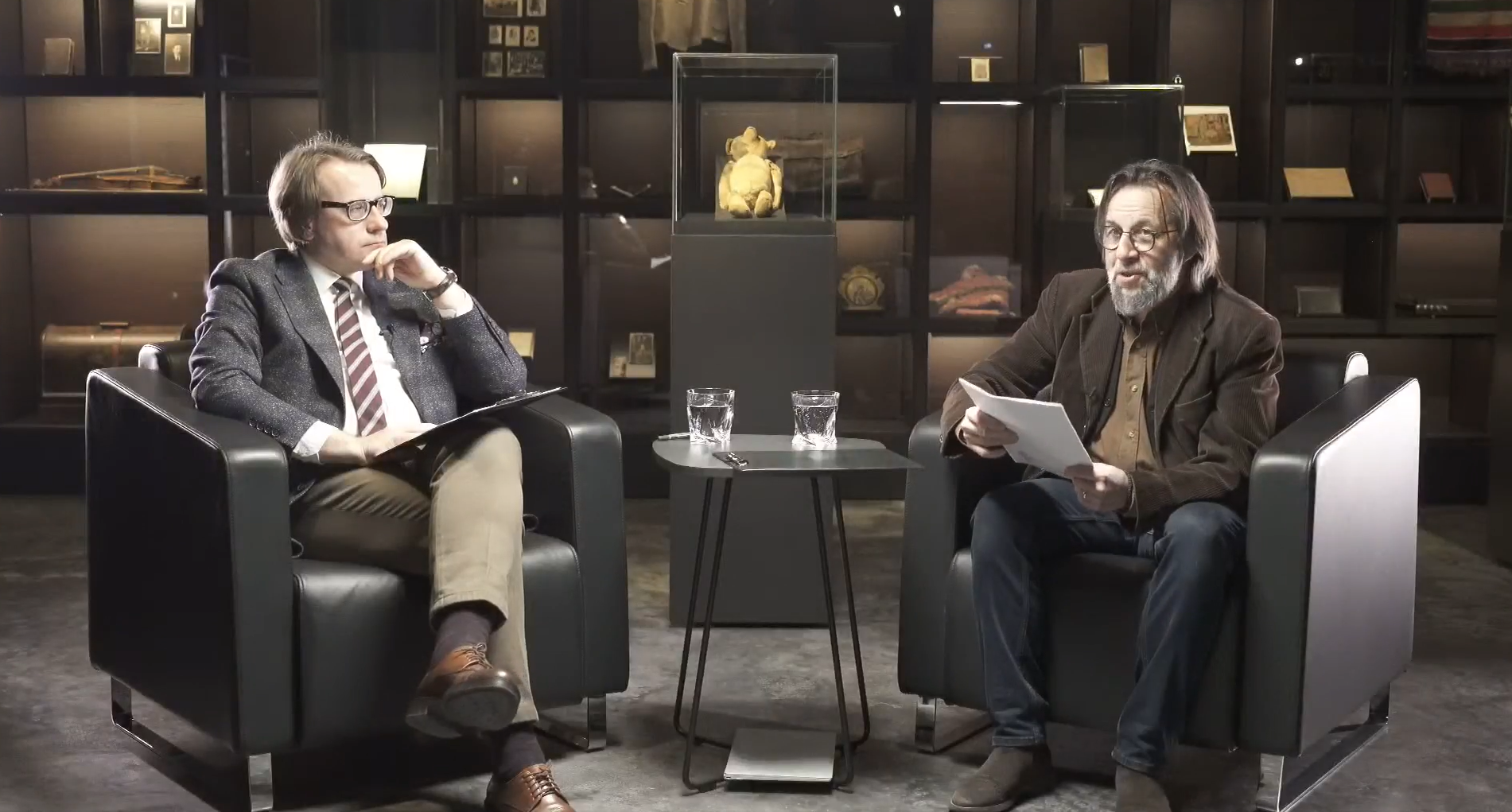
Another topic of the meeting was the confrontation with Russia’s totalitarian and fascist legacy. Basil Kerski noted that the era of Putinism represents a transformation within an authoritarian system. Each conversation within the “Soul of Sybir” Borderline Experiences Workshop, including this one, took place in front of a display case presenting a specially selected object from the collections of the Sybir Memorial Museum. This time it was a card with photographs depicting meetings and conversations between representatives of the Soviet Union and the Third Reich in September 1939 in Białystok. Looking at these images prompted the guest of the meeting to reflect on how great a falsification of history it is when Vladimir Putin claims that the invasion of Ukraine is a fight against fascism.